You have been told your gallbladder needs to come out. Perhaps the pain under your right ribs keeps returning after dinner, or an ultrasound has confirmed gallstones and your doctor has used the word cholecystectomy. Either way, the questions that follow are usually practical ones. What exactly will be done? Will I be awake? How big will the scars be? When can I get back to work and eat normally?
This guide answers those questions. It walks through laparoscopic (keyhole) gallbladder surgery step by step: the checks before the operation, what the surgeon does while you are asleep, how keyhole surgery compares with open surgery, what recovery usually looks like, and which symptoms afterwards need a prompt call to your doctor.
If you are still deciding whether you need surgery at all, start with our page on gallbladder stones, which explains when treatment is advised and when stones can simply be watched.
A quick refresher: why the gallbladder is removed
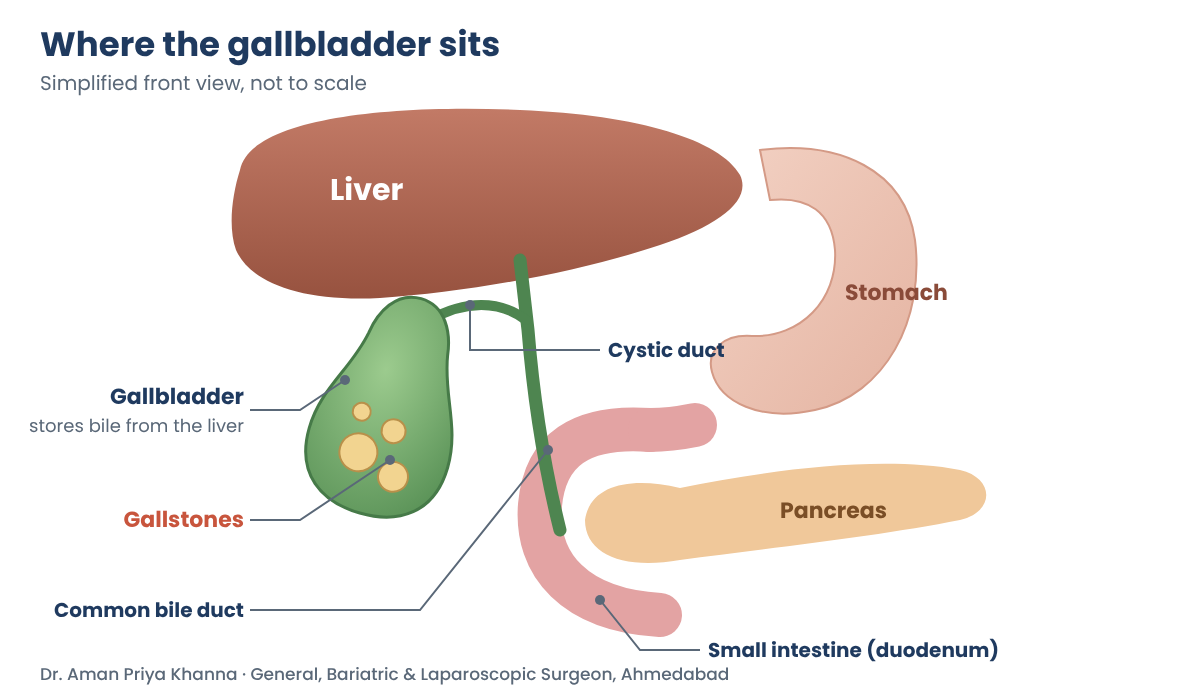
The gallbladder is a small pouch tucked under the liver. The liver makes bile, a digestive fluid that helps break down fat, and the gallbladder stores some of it and squeezes it out after meals.
Gallstones form when the chemistry of bile goes out of balance and crystals harden into stones. Many people carry gallstones for years without knowing. The trouble starts when a stone blocks the gallbladder’s outlet or slips into the bile duct. That can cause attacks of upper abdominal pain, often after a heavy meal, and sometimes more serious problems such as an infected gallbladder, jaundice or pancreatitis.
Not every gallstone needs an operation. If a scan picks up stones by chance and they have never caused symptoms, they are usually watched rather than removed. But once stones have started causing attacks or complications, removing the gallbladder is the standard, definitive treatment. Surgeons do not simply remove the stones, as the gallbladder that formed them would usually go on to form more.
Before surgery: the checks you can expect
Gallbladder surgery is planned around a clear picture of your stones and your general health. Depending on your situation, the assessment may include:
- An abdominal ultrasound. This is usually the first and most useful test for confirming gallstones.
- Blood tests. Liver function tests and markers of inflammation help show whether a stone may be affecting the bile duct, liver or pancreas.
- Further imaging when needed. If a stone is suspected in the bile duct, your surgeon may advise an MRCP (a specialised MRI scan) or another test. A stone in the duct is often removed separately, through an endoscopic procedure called ERCP, either before the operation or alongside it.
- A fitness check for anaesthesia. This often includes blood tests and, depending on your age and health, an ECG or chest X-ray.
This is also the time to tell your surgical team about every medicine and supplement you take, especially blood thinners, diabetes medicines and herbal products, since some may need to be paused or adjusted. You will be told when to stop eating and drinking before the operation. Follow those instructions exactly, because an empty stomach makes anaesthesia safer.
It also helps to plan the practical side early: someone to take you home, someone to stay with you for the first day if you go home the same day, and a word with your employer about time off.
What happens during laparoscopic gallbladder removal
The medical name for the operation is laparoscopic cholecystectomy. Here is what typically happens, in order.
- You are put to sleep. The operation is performed under general anaesthesia, so you are fully asleep and feel nothing. An anaesthetist monitors your breathing, heart and blood pressure throughout.
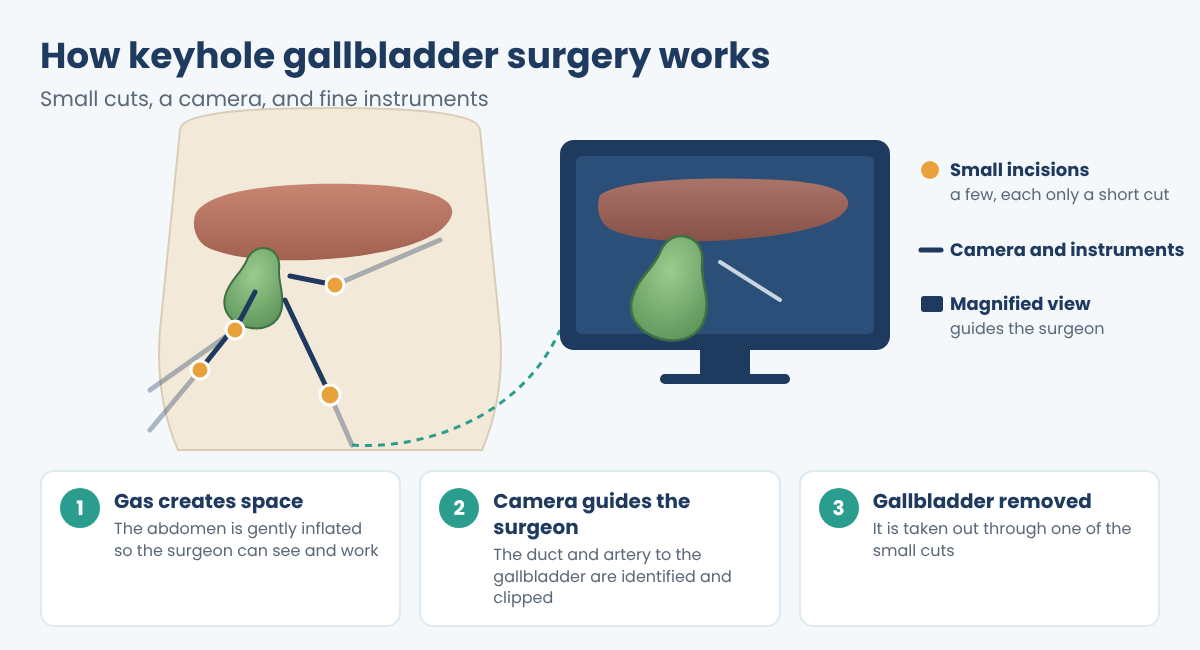
- Small cuts are made. Instead of one large opening, the surgeon makes a few small incisions, usually one near the belly button and the others in the upper abdomen.
- The abdomen is gently inflated. Carbon dioxide gas is passed into the abdomen, raising the abdominal wall like a tent so the surgeon has working space and a clear view.
- A camera guides the operation. A laparoscope, a slim telescope with a light and camera, is passed through one incision. It sends a magnified image to a screen. The surgeon then works with fine instruments passed through the other small cuts.
- The key structures are confirmed. Before cutting anything, the surgeon clearly identifies the duct and artery that supply the gallbladder. This careful step is the main safeguard against injury to the main bile duct. Some surgeons also inject dye and take an X-ray of the bile ducts (a cholangiogram) during the operation to check for stones there.
- The gallbladder is sealed off and freed. The duct and artery are closed with small clips, and the gallbladder is separated from the underside of the liver.
- The gallbladder is removed. It is taken out through one of the small incisions, often inside a protective bag.
- The cuts are closed. The gas is released and the small wounds are closed with stitches, skin glue or adhesive strips.
A straightforward operation usually takes about an hour or less. It can take longer if the gallbladder is inflamed or scarred.
Will I be awake during the operation?
No. Laparoscopic gallbladder removal is done under general anaesthesia, so you are asleep for the whole procedure. Before surgery, the anaesthetist will review your health, explain how pain will be controlled, and answer your questions.
What if the surgeon has to switch to open surgery?
Occasionally a keyhole operation is changed to an open one during surgery. This is more likely when the gallbladder is severely inflamed, when there is heavy scarring from earlier operations, or when the anatomy cannot be seen clearly enough to proceed safely. Switching is a safety decision, not a failure. It simply means the surgeon judged that a larger incision was the safer way to finish the operation. Your surgeon should discuss this possibility with you beforehand.
Laparoscopic vs open gallbladder surgery
Both approaches remove the gallbladder in the same way. The difference is how the surgeon reaches it.
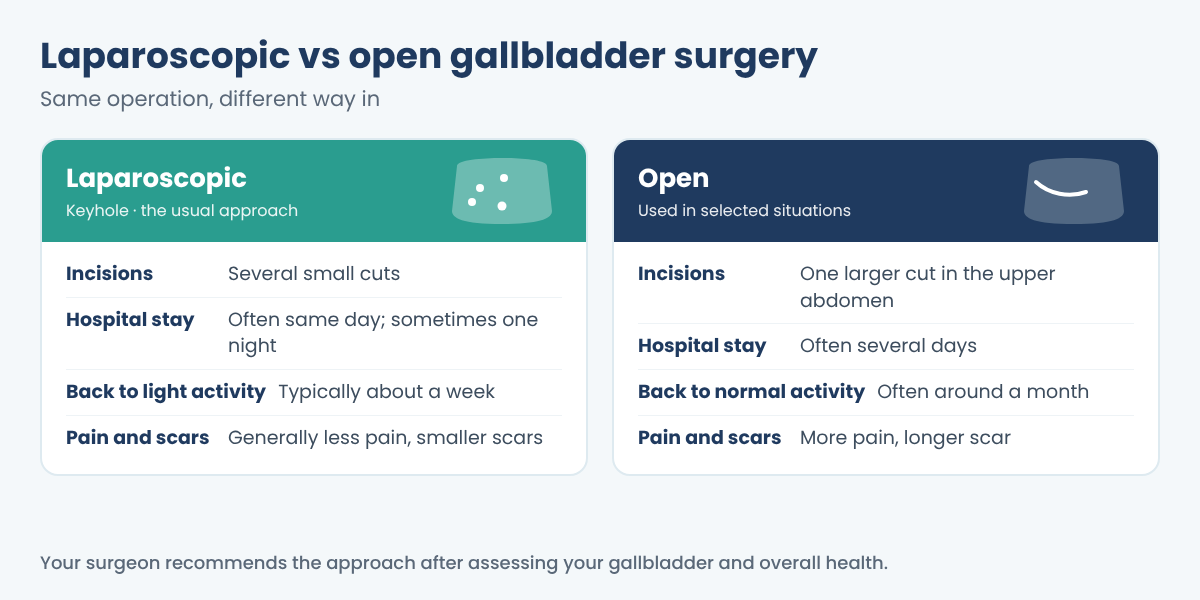
| Laparoscopic (keyhole) | Open | |
|---|---|---|
| Incisions | Several small cuts | One larger cut in the upper abdomen |
| How often it is used | The usual approach for most patients | Reserved for selected situations, or when keyhole surgery cannot be completed safely |
| Hospital stay | Many patients go home the same day; some stay one night | Often several days, sometimes up to a week |
| Return to normal activities | Typically about a week for light activities | Often around a month |
| Pain and scarring | Generally less pain and smaller scars | More pain and a longer scar |
Because it usually means less pain, smaller scars and a faster return to normal life, laparoscopic surgery is the standard approach for gallbladder removal.
Recovery after gallbladder surgery: a realistic timeline
Everyone heals at a different pace, and an operation on an inflamed gallbladder can take longer to recover from. The outline below is what many people experience after a planned keyhole operation.
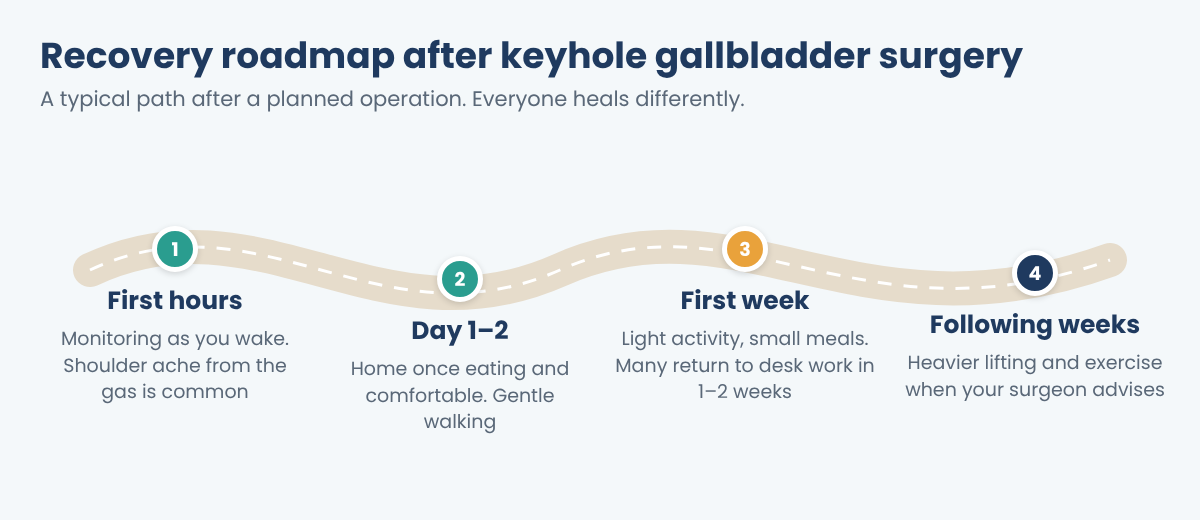
The first few hours. You wake up in a recovery area and are monitored as the anaesthetic wears off. Some people feel drowsy or nauseous. An ache in one or both shoulders is common. It is caused by the carbon dioxide gas irritating the diaphragm, and it usually eases over a day or two. Gentle walking helps.
The first day or two. Many patients go home the same day, once they are eating, passing urine and their pain is controlled. Others stay one night. If you go home the same day, have an adult stay with you for the first 24 hours.
The first week. Expect some tiredness, mild wound soreness and occasional bloating. Take the pain relief prescribed for you as directed, and walk a little more each day. Many people with desk-based jobs return to work within one to two weeks.
The weeks that follow. Heavier lifting, strenuous exercise and physically demanding work usually wait a little longer. Your surgeon will tell you when it is safe to resume these and when you can drive.
Eating after gallbladder removal
Most people do not need a long-term special diet. After surgery, bile drains straight from the liver to the intestine rather than collecting in the gallbladder first, and the body adjusts to this well.
In the first days, small, light meals are often easier to manage. Some people find their bowel motions are looser or more frequent for a few weeks, and occasionally longer. Building up a balanced diet with enough fibre, and reintroducing richer foods gradually, can help. If diarrhoea persists, mention it at your follow-up.
Caring for your wounds
Keep the small wounds clean and dry, and follow your team’s advice about dressings and when you can shower. The scars are usually small and tend to fade over the following months.
Follow-up
A follow-up visit lets your surgeon check how your wounds are healing, review any test results and answer questions. Bring up anything that seems unusual, even if it feels minor.
Risks and possible complications
Laparoscopic gallbladder removal is one of the most commonly performed operations and is generally safe, but no surgery is free of risk. Possible complications include:
- Bleeding, during or after surgery
- Wound infection, usually treatable with antibiotics
- Bile leak, where bile escapes into the abdomen and may need drainage or a further procedure
- Injury to the main bile duct or nearby organs, which is uncommon but is the most significant risk particular to this operation, and may need further surgery to repair
- A stone left in the bile duct, which can cause pain or jaundice later and may need an endoscopic procedure
- Blood clots in the legs, which is why you are encouraged to walk early, and why some patients are given compression stockings or blood-thinning injections
- Digestive symptoms such as indigestion, bloating or diarrhoea, which usually settle with time
- The general risks of anaesthesia, which your anaesthetist will discuss based on your health
Your own level of risk depends on your general health, how inflamed the gallbladder is, and whether there are stones in the bile duct. Your surgeon should explain this to you specifically before you consent.
When to contact your doctor urgently after surgery
Some discomfort is expected after any operation. Contact your surgical team promptly, or seek urgent medical care, if you notice:
- pain that is severe, getting worse, or not controlled by your prescribed pain relief
- a high temperature, chills or shivering
- yellowing of the skin or the whites of the eyes
- redness, swelling, pus or increasing pain around a wound
- persistent vomiting, or being unable to keep fluids down
- pain, swelling or tenderness in one leg
Go to the nearest emergency department straight away if leg pain or swelling comes with breathlessness or chest pain, as this can signal a blood clot in the lungs.
Frequently asked questions
Can I live normally without a gallbladder? Yes. The liver keeps making bile; it now drains straight into the intestine without being stored first. Most people live normally without a gallbladder, and long-term problems are uncommon.
Why take out the gallbladder rather than just the stones? The stones form inside the gallbladder. If only the stones were taken out, the gallbladder would usually go on to form new ones. Removing the gallbladder treats the source of the problem.
Is keyhole gallbladder surgery done with a laser? No. “Laparoscopic” refers to the camera and fine instruments used through small incisions. Lasers are not used to remove the gallbladder.
How long will I need off work? It depends on your job and how you recover. Many people with office-based work return within one to two weeks, while physically demanding jobs need longer. Your surgeon can advise you based on your work and your operation.
Will the scars be noticeable? Keyhole surgery leaves a few small scars rather than one long one. They are usually small and fade over time, but every operation leaves some mark, and how scars heal varies from person to person.
Can gallstones come back after the gallbladder is removed? Stones cannot form in a gallbladder that is no longer there. Rarely, a stone can be found in the bile duct after surgery, which is a separate problem your surgeon can treat.
Is every gallbladder operation done laparoscopically? Most are, but not all. A severely inflamed gallbladder, scarring from earlier surgery or unclear anatomy may mean an open operation is safer, either planned in advance or decided during surgery.
Considering gallbladder surgery in Ahmedabad?
If you have gallstones that are causing pain, or you have been advised to have your gallbladder removed and want a clear explanation of what it would involve, a consultation with Dr. Aman Priya Khanna, general, bariatric and laparoscopic surgeon in Ahmedabad, can help. He can review your reports, explain whether surgery is needed and when, and walk you through the procedure and recovery for your situation. Book a consultation, in person or online.
This article is general patient information and does not replace advice from your own doctor. Whether you need surgery, and how it is done, depends on an individual clinical assessment.