A lot of people in India rule themselves out of bariatric surgery before they ever speak to a surgeon. They read somewhere that you need a BMI of 40, do the maths, land at 33 or 34, and decide surgery is only for people much heavier than them. You can weigh 80 kg and still believe bariatric surgery is meant for people who weigh 150 kg or more.
That number is out of date, and for Indians in particular it was never a good fit.
The international guidelines on who should be offered weight loss surgery were rewritten in 2022, and they now say plainly that the thresholds should be lower for Asian populations. Indian surgical guidelines follow a similar logic. This article walks through what the current criteria actually are, why they are different for Indians, what else a surgeon looks at besides your BMI, and what a sensible next step looks like if you think you might qualify.
Why the “BMI 40” rule is outdated
For about thirty years, eligibility for bariatric surgery around the world was based on a 1991 US National Institutes of Health consensus statement. It set the bar at a BMI of 40, or 35 if you also had a serious weight-related illness.
These older thresholds still matter in one important place: health insurance. IRDAI, India’s insurance regulator, still follows them. Under IRDAI’s standard rules, for bariatric surgery to be covered by your health insurance you need to be 18 or older, the surgery must be advised by a doctor and supported by clinical protocols, and your BMI must be 40 or above, or 35 or above with a serious condition such as uncontrolled type 2 diabetes, coronary heart disease, obesity-related cardiomyopathy or severe sleep apnoea, after less invasive weight-loss methods have not worked. Insurers apply these rules in their own ways, so always check your policy wording.
In 2022, the American Society for Metabolic and Bariatric Surgery (ASMBS) and the International Federation for the Surgery of Obesity and Metabolic Disorders (IFSO) published joint guidelines intended to replace it. Their main recommendations are:
- Surgery is recommended for people with a BMI of 35 or above, whether or not they have obesity-related health problems.
- Surgery should be considered for people with a BMI of 30 to 34.9 who have metabolic disease, such as type 2 diabetes.
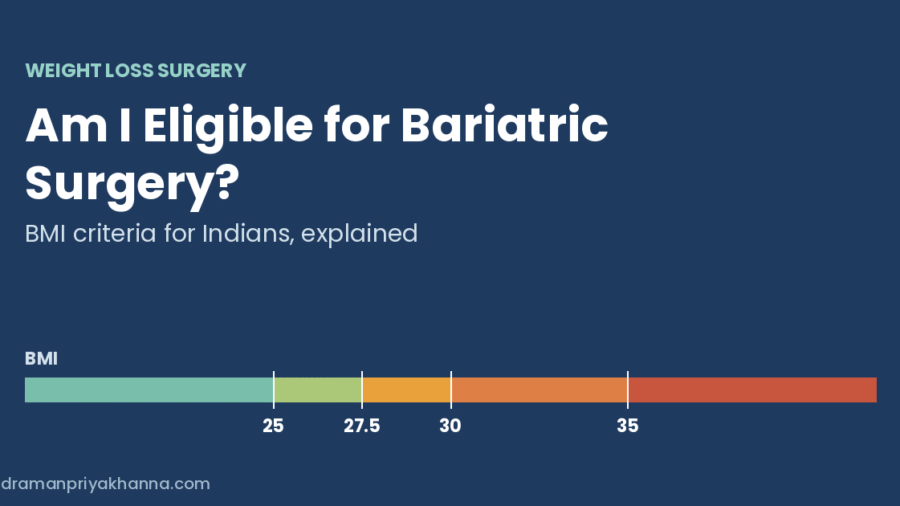
- For Asian populations, a BMI of 25 or above already suggests clinical obesity, and people with a BMI of 27.5 or above should be offered surgery.
That last point is the one most Indian readers have never heard, and it changes the picture considerably.
Why the thresholds are lower for Indians
BMI is a rough measure. It divides weight by height and says nothing about where the weight sits or how much of it is fat.
That matters because Asian Indians tend to carry more body fat at the same BMI than people of white European descent, and more of it around the abdomen and internal organs. A national consensus statement published in the Journal of the Association of Physicians of India noted exactly this pattern: excess body fat, abdominal fat, and fat deposited in the liver and muscle, along with a strong link to type 2 diabetes and metabolic syndrome. Its conclusion was that the “normal” BMI range for Asian Indians is narrower and lower than for Western populations.
In everyday terms, a person in Ahmedabad with a BMI of 30 may already be carrying the kind of health risk that a Western guideline would only flag at a much higher number. Waiting until you reach a Western cut-off can mean waiting until diabetes, blood pressure or fatty liver are already well established, which means losing precious healthy years.
What Indian guidelines say
The Obesity and Metabolic Surgery Society of India (OSSI), the national body for bariatric surgeons, has published its own guidance. Two points stand out.
In its 2020 guidelines, OSSI said bariatric or metabolic surgery should be considered for suitable Indian patients with a BMI of 35 or above, with or without weight-related illness, and for those with a BMI of 30 or above who have two or more obesity-related conditions. Its 2024 obesity management guidelines went further, describing surgery as a primary treatment option for patients with a BMI of 35 or above.
OSSI has also been clear on one point that patients often get wrong: bariatric surgery is not cosmetic surgery. It treats a chronic disease and the conditions that come with it.
Where you might fall: a quick guide
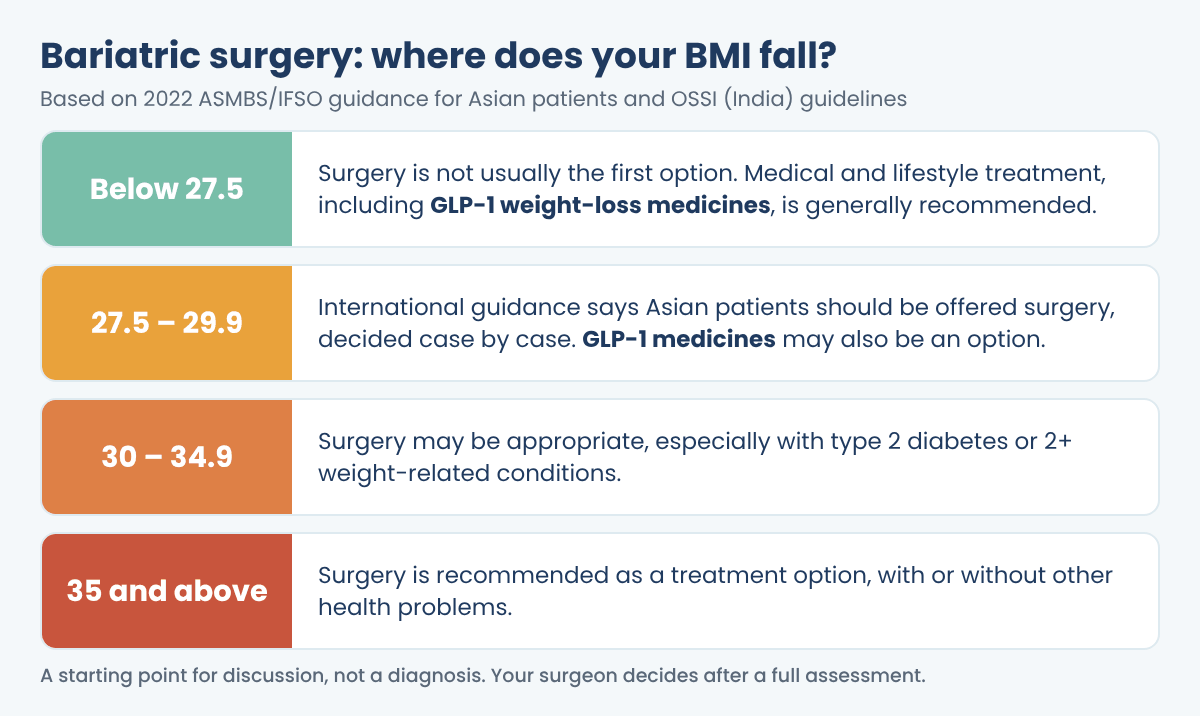
| Your BMI | What the current guidelines suggest |
|---|---|
| Below 27.5 | Surgery is not usually the first option. Medical and lifestyle treatment, including GLP-1 weight-loss medicines, is generally recommended. |
| 27.5–29.9 | International guidance says Asian patients in this range should be offered surgery. Suitability depends heavily on your health conditions and is decided case by case. GLP-1 medicines may also be an option. |
| 30–34.9 | Surgery may be appropriate, especially with type 2 diabetes or two or more weight-related conditions. |
| 35 and above | Surgery is recommended as a treatment option, with or without other health problems. |
GLP-1 medicines are prescription weight-loss medicines that act on appetite and blood sugar. They need a doctor’s supervision and are not suitable for everyone.
The guidelines do not agree perfectly with each other, and this table is a starting point for a conversation, not a verdict. A surgeon will weigh your BMI alongside everything else described below.
How to work out your BMI
BMI is your weight in kilograms divided by your height in metres, squared. To skip the maths, use our BMI calculator.
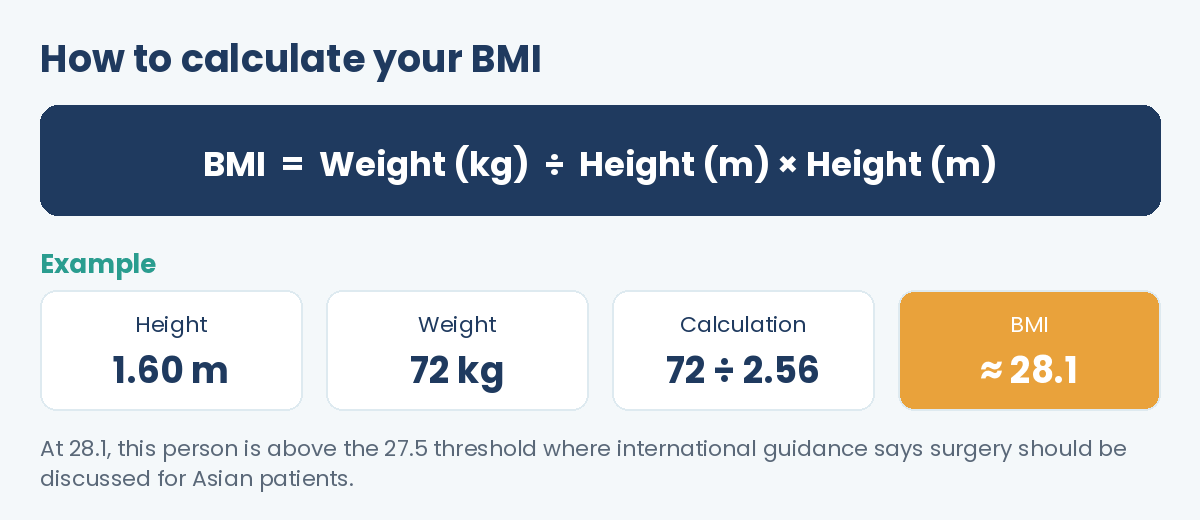
Take someone who is 1.60 m tall and weighs 72 kg. Their height squared is 2.56, and 72 divided by 2.56 gives a BMI of about 28.1. Under the old rules, that person would never have been considered. Under current international guidance for Asian patients, they would be in the range where surgery should at least be discussed, particularly if they have diabetes or high blood pressure.
BMI is not the whole assessment
Meeting a BMI threshold makes you a potential candidate. It does not make you a confirmed one. A responsible bariatric team looks at several other things.
Weight-related health conditions. Type 2 diabetes, high blood pressure, sleep apnoea, fatty liver disease and joint problems all strengthen the case for surgery, because these are the conditions surgery is often able to improve. The 2022 international guidelines specifically recommend surgery for people with type 2 diabetes and a BMI of 30 or more.
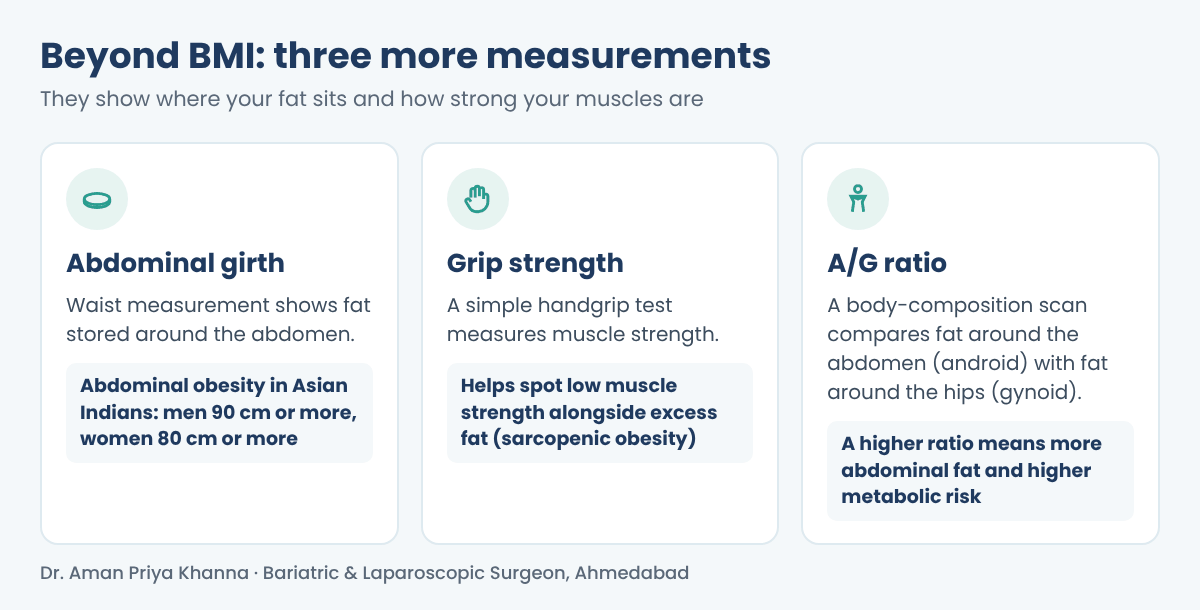
Abdominal girth. Where your fat sits matters as much as how much you weigh. A waist measurement shows how much fat is stored around the abdomen, which carries more metabolic risk. For Asian Indians, a waist of 90 cm or more in men and 80 cm or more in women indicates abdominal obesity, according to the 2025 revised definition of obesity in Asian Indians.
Grip strength. A simple handgrip test measures muscle strength. It helps your team spot low muscle strength alongside excess fat, sometimes called sarcopenic obesity, so that muscle can be protected while you lose weight.
A/G ratio. A body-composition scan can compare the fat around your abdomen (android fat) with the fat around your hips and thighs (gynoid fat). A higher android-to-gynoid (A/G) ratio means more fat is concentrated around the abdomen, which is linked to higher metabolic risk such as insulin resistance.
Your weight history. Your surgeon will want to know what you have already tried, how long you have struggled with your weight, and what has happened when you have lost weight before.
Your overall fitness for surgery. Bariatric operations today are usually performed laparoscopically, through small incisions, but they are still major procedures under general anaesthesia. Your heart, lungs and other medical conditions will be assessed to make sure the operation is safe for you.
Your readiness for life afterwards. This is the part people underestimate. Surgery permanently changes how you eat. The US National Institute of Diabetes and Digestive and Kidney Diseases (NIDDK) suggests asking yourself whether you understand what the operation involves, whether you understand how your eating and activity will need to change, and whether you have considered the cost of both surgery and follow-up care.
What the evaluation usually involves
Before surgery is confirmed, most centres carry out a structured assessment rather than a single consultation. Depending on your health, this can include:
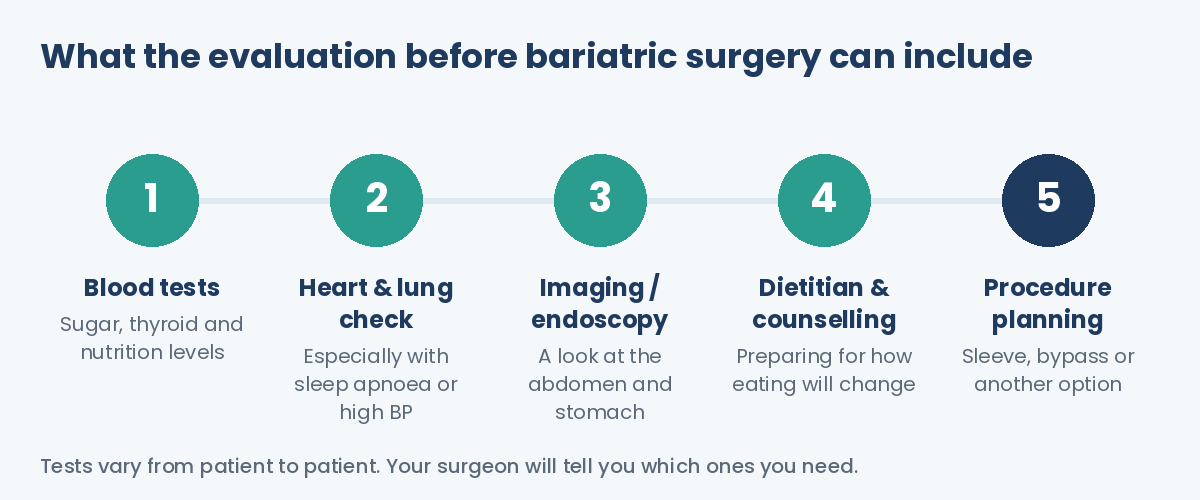
- blood tests, including checks on blood sugar, thyroid function and nutritional status
- body measurements such as waist circumference, grip strength and body composition
- an assessment of heart and lung health, especially if you have sleep apnoea or high blood pressure
- imaging of the abdomen, and sometimes an endoscopy to look at the stomach
- a review with a dietitian, and in some cases with a psychologist or psychiatrist
- a discussion of which operation, such as sleeve gastrectomy or gastric bypass, suits your situation best
Some teams also ask patients to lose a small amount of weight or stop smoking before surgery, because both can make the operation safer.
When surgery may not be the right choice, or not yet
An honest assessment sometimes ends with “not now” rather than “yes”. That can happen if a medical condition makes anaesthesia too risky at present, if an eating disorder, alcohol or substance use problem or a psychiatric condition is not yet under control, or if a person is not in a position to commit to long-term follow-up.
None of this is meant to shut a door. In many cases the right approach is to treat the other issue first and revisit surgery later.
The risks you should know about
All surgery carries risk, and bariatric surgery is no exception. Possible problems include bleeding, infection, leaks where the stomach or intestine has been joined, and the need for a further operation. Weight regain is possible if eating habits slip over the years. Most patients also need long-term vitamin and mineral supplements and regular follow-up blood tests.
That said, safety has improved a great deal. When the 2022 guidelines were announced, a former president of the ASMBS described the mortality risk as roughly one in a thousand. Your own risk depends on your age, health and the procedure chosen, and your surgeon should go through it with you specifically.
What to do next
If your BMI is 27.5 or higher, and especially if you also have diabetes, high blood pressure, sleep apnoea or fatty liver, it is worth having a proper consultation rather than relying on an online calculator.
A good first appointment should give you a clear answer on whether you are a candidate, which procedure might suit you, what the evaluation process involves, and what life looks like in the first year afterwards. It should also leave room for the answer to be “not yet”.
Frequently Asked Questions
Can I get bariatric surgery with a BMI of 30 if I don’t have diabetes? Possibly. International guidance says Asian patients with a BMI of 27.5 or above should be offered surgery, while Indian guidelines put more weight on whether you have obesity-related conditions at a BMI between 30 and 35. Because the guidelines differ, this is a decision your surgeon will make after a full assessment.
Is bariatric surgery a cosmetic procedure? No. The Obesity and Metabolic Surgery Society of India has stated clearly that bariatric and metabolic surgery is not cosmetic surgery. It is a treatment for obesity and related diseases such as type 2 diabetes.
Is there an age limit for bariatric surgery? There is no single fixed upper age limit. The 2022 international guidelines say appropriately selected teenagers can be considered, and older adults are assessed individually based on their overall health.
Do I need to lose weight before bariatric surgery? Some teams ask patients to lose a modest amount of weight beforehand, mainly to make surgery safer and the liver easier to work around. Your surgeon will tell you whether this applies to you.
Will my health insurance cover bariatric surgery? It can. Under IRDAI’s standard rules, insurance cover generally applies when you are 18 or older, the surgery is advised by a doctor, and your BMI is 40 or above, or 35 or above with a serious condition such as uncontrolled type 2 diabetes, coronary heart disease, obesity-related cardiomyopathy or severe sleep apnoea, after other weight-loss methods have not worked. Check your policy wording and waiting periods with your insurer before planning surgery.
How long does the evaluation take? It varies. Some people complete their tests within a few weeks, while others need longer if conditions such as diabetes or sleep apnoea need to be optimised first.
Will I need to take supplements for life? Most bariatric patients need long-term vitamin and mineral supplements and periodic blood tests. The exact plan depends on the operation you have.
Talk to a Bariatric Surgeon in Ahmedabad
Not sure where you stand? If your BMI is above 27.5, or you are living with diabetes, high blood pressure or fatty liver alongside excess weight, a consultation with Dr. Aman Priya Khanna, bariatric and laparoscopic surgeon in Ahmedabad, can give you a clear, honest answer on whether surgery is right for you, and what the alternatives are if it is not. Book a consultation to get started.